MENULUX BLOG
Restaurant Robots: An Operational Evaluation and the Advantages and Disadvantages of Robot Waiters
Menulux POS Systems · April 16, 2026Minutes spent waiting for a waiter during a busy dinner service, room service that hasn’t arrived for hours in a hotel room — moments everyone has experienced. During peak times when staff can’t keep up, robot waiters are increasingly coming to the forefront as an operational solution.
These systems, whose numbers are rapidly increasing in restaurants and hotels, offer an innovative experience while also promising efficiency. But are they truly the future of the service industry, or just a passing trend? In this article, we examine what robot waiters are, how they work, their advantages and disadvantages, and whether they are worth the investment, backed by technical data.
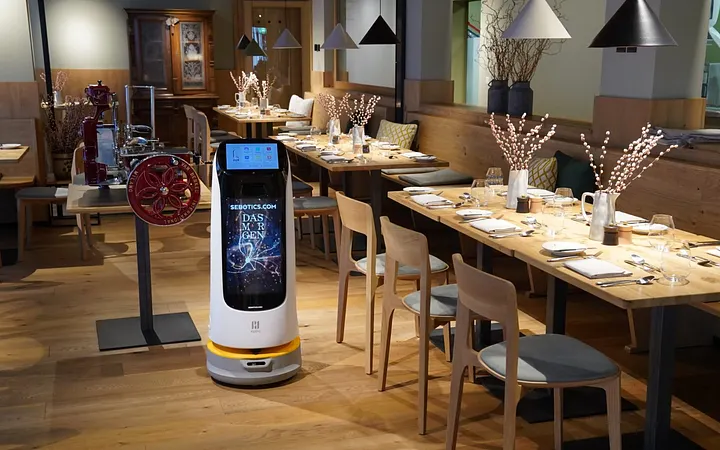
What Is a Robot Waiter?
A robot waiter is an autonomous device designed to perform tasks such as serving food, taking orders, or clearing tables in restaurants. Unlike traditional service staff, these machines move through dining areas using sensors, artificial intelligence, and pre-programmed routes. Produced in various form factors ranging from humanoid designs to tray-carrying platforms, robot waiters are tailored to different operational needs.
Technology companies are developing robot waiters for use in hotels, restaurants, museums, and many other areas. With continuous updates, these machines are becoming smarter and more practical. So how exactly do these robots work?
How Do Robot Waiters Work?
The core functioning of robot waiters is based on the combination of several advanced technologies:
Navigation: Using LIDAR sensors, cameras, and mapping software, robots can move in crowded dining halls without colliding with tables or people. They follow predefined routes or calculate a new path in real time when encountering obstacles. Pudu Robotics’ PuduBOT model provides highly precise navigation with ultra-wideband positioning and SLAM (Simultaneous Localization and Mapping) technology, allowing up to 100 robots to operate simultaneously in a single area.
Delivery Process: Staff load food onto the robot’s trays, enter the table number, and send it off. Advanced models integrate with the restaurant’s POS system, enabling orders to be transmitted directly to the robot.
Customer Interaction: Some service robot models are equipped with touchscreens or voice recognition features. They can greet guests, recommend signature dishes, or provide directions. PuduBOT stands out with its friendly facial expressions displayed on its screen and voice interaction features.
Task Cycle and Charging: Finding temporary staff during peak seasons or unexpected customer surges is a serious challenge. In such situations, renting a service robot offers a practical solution to ease the workload and maintain service levels when human resources fall short.
Advantages and Disadvantages of Robot Waiters
As with any technology, robot waiters have both strengths and weaknesses. Let’s evaluate them with operational data.
Advantages
Solution to Staffing Problems: Finding temporary staff during peak seasons or unexpected customer surges is a major challenge. In such cases, renting a service robot provides a practical solution to ease the workload and maintain service levels when human resources are insufficient.
Increases Operational Efficiency: Robot waiters reduce waiting times, especially during busy hours, and increase table turnover rates. Models with multiple trays can carry 6–8 plates at once and serve multiple tables in a single trip. This reduces the need for waiters to constantly move between the kitchen and dining area, improving overall service flow. Experience from Robot Cafe in Kenya shows that robots can attract customers as a curiosity-driven element.
Consistent Performance: Robots do not get tired or have “off days.” They deliver the same level of predictable performance every shift. Cooking robots used in the VINI Smart Restaurant in Qingdao can produce over 100 servings in an hour and a half during lunch hours and stand out with their price-performance balance.
Increases Revenue Potential: By making food delivery and plate collection more efficient, service robots increase table turnover rates, allowing staff to focus more on guests, upsell, and boost tip income.
Also Active in the Kitchen: Robots are not only active in the service area but also in the kitchen. Cooking robots used in a chain restaurant in Wuxi, Jiangsu can prepare 70% of the existing dishes and reduce cooking time by 60%. Each costing 60,000 yuan (approximately $8,300), these robots provide staff savings and consistent taste standards.
Disadvantages
Initial Investment: Although the long-term benefits are promising, the initial investment for restaurant robots remains a significant cost item for some businesses. When integration, training, and maintenance costs are added, the total can become quite high. However, flexible leasing options help overcome this barrier. Mohammed Abbas, owner of Robot Cafe in Kenya, notes that importing robots is quite expensive, but the investment pays off thanks to curious customers.
Lack of Human Touch: Robots are efficient, but they cannot pick up on subtle cues such as a guest’s mood or tone. They cannot provide the warm, personal touch and emotional sensitivity that human waiters offer. John Kariuki, manager of Robot Cafe in Nairobi, emphasizes that robots cannot fully deliver all services without the human touch. While some guests prefer robot service, others still seek human warmth.
Technical Issues: Like any machine, robots can occasionally experience navigation problems or system errors. Even with strong after-sales support, minor disruptions can occur. Therefore, quick response plans and regular maintenance are essential.
Should Your Restaurant Invest in a Robot Waiter?
The decision to incorporate robot waiters into your restaurant depends on your business’s unique conditions. Here are a few key points to help you decide:
Type of Restaurant: High-volume venues such as fast-casual restaurants, hot pot restaurants, buffets, or large cafeterias benefit the most from robots. Speed, efficiency, and smooth coordination are critical for these types of places. In fine dining or boutique restaurants, where personal service is at the forefront, service robots can be positioned as a supportive tool rather than a main element.
Budget: If you are considering purchasing a restaurant robot, the initial cost may seem high, and it may take time to amortize through labor savings. However, thanks to leasing options, many restaurants—especially during peak seasons when it is difficult to find temporary staff—find the cost manageable and even economical.
Customer Profile: Younger and tech-savvy customers enjoy the novelty and convenience of robot service, sharing their experiences on social media and providing free marketing for the business. On the other hand, more traditional guests may prefer warm human interaction. Knowing your customer base and striking the right balance is important.
Staffing Needs: If you are experiencing difficulties in finding or retaining staff—as many restaurants have after the pandemic—robot waiters can provide significant support. They do not replace good staff, but by taking over repetitive tasks, they ease the workload and allow your team to focus on delivering quality service. A cooking robot used in a corporate cafeteria in Shandong replaced the workload of four chefs, eliminating the need for additional staff.
Conclusion
Restaurant service robots are changing operational dynamics in the food service industry. They offer a modern touch that is fast, reliable, and appealing to customers. Despite their disadvantages, these smart assistants have the potential to make the dining experience more efficient and enjoyable. The key is not to replace human warmth with technology, but to position it as a complementary element.
According to the Robot Waiters Global Strategic Business Report published by Research and Markets, the global robot waiter market was valued at $638.7 million in 2024 and is expected to reach $3.7 billion by 2030, growing at a compound annual growth rate of 33.8%. Coherent Market Insights predicts that the restaurant robot market will reach $2 billion in 2026 and $60 billion by 2033. These figures show that the sector is not just a trend, but part of a lasting transformation.
Frequently Asked Questions
Are Robot Waiters Worth the Investment?It depends on your goals. For a busy restaurant, efficiency and innovation can make the investment worthwhile by increasing profit and customer satisfaction. Smaller venues or businesses that prioritize personal service may not see the same returns.
How Does a Service Robot Know Where to Go?Service robots use advanced navigation technology, including sensors, cameras, and pre-programmed maps, to determine their routes. With LIDAR and AI algorithms, they can detect obstacles, avoid collisions, and follow designated paths.
Will Robots Replace Humans?As hospitality expert Edith Ojwang states, there is plenty of room for both robot and human service to coexist. While some customers prefer robot service, others seek human warmth. This diversity shows that robots are not a complete threat to the human workforce.
In Which Industries Are Robots Used?In addition to restaurants, they are increasingly used in hotels for room service, in hospitals for delivering medicine and meals, in retail for inventory transport, in industrial facilities for material handling, and in e-commerce warehouses for order fulfillment.
How Much Weight Can Robots Carry?Light service-type robots can carry 1–5 kg of drinks and desserts, while medium-duty robots offer an ideal capacity of 5–20 kg for most restaurants. Heavy-duty robots can carry loads between 20–60 kg.
Thousands of businesses in more than 20 countries are growing their operations with Menulux. Contact us now to work with Menulux, which offers Turkey’s leading POS Systems, Kiosk System, QR menu, and digital menuboard solutions.


 Nida Kule, Atasehir Barbaros Mah.
 0850 346 6586
 info@menulux.com