MENULUX BLOG
Documents Required to Open a Business in 2025 and the Licensing Process (Updated Guide)
Menulux POS Systems · September 29, 2025
Do you dream of starting your own business but don’t know where to begin? For many entrepreneurs, the most exciting step is opening their own workplace. However, the paperwork and licensing process can often seem confusing.
In this guide, you will find which documents you need to open a business in 2025, how to proceed step by step through the licensing process, what additional permits are required depending on the sector, and the most common mistakes entrepreneurs make.
Every year, tens of thousands of new businesses are opened in Turkey. However, 28% of entrepreneurs delay the process for weeks due to missing or incorrect documents. (Source: TURKSTAT)
Step-by-Step Guide to Opening a Business in 2025
Opening a business is not limited to collecting documents; proper planning is just as important as the paperwork. First, define your target customer base and clarify your cost–revenue balance. Your business plan must include a description of your product or service, customer capacity, pricing, and competitor analysis.
Additionally, the NACE code you determine in your business plan will be decisive both for KOSGEB supports and official license applications. Choosing the wrong code may result in both missing out on support and rejection of your application. For the correct code selection, you can review the up-to-date NACE code guide of the Istanbul Chamber of Commerce. Be sure to get support from an expert on this matter.

Location and Premises Selection
Location selection can have a major impact on the success of a business. Even the best business idea opened in the wrong place can close in a short time. Therefore, choosing a place that complies with zoning plans, is accessible, and is located in areas with high customer traffic provides advantages.
For example, if you try to open a café in a place with a zoning status of “residential,” the municipality will reject your license. Additionally, the lease agreement must be notarized, and title deed documents must be complete. Missing documents can delay your obtaining a license from the municipality.
Documents and Mandatory Permits for Opening a Business by Sector
Each sector has its own legal requirements. Your business plan may be ready and your premises suitable; however, you cannot open a business without additional documents depending on your field of activity.
Food Sector: Food production permit from the Ministry of Agriculture and Forestry, hygiene certificates and health reports for employees are mandatory. Additional documents are especially required for cafés and restaurants. For details, you can check our article What You Need to Know to Open a Restaurant and Café. Similarly, there are different permits for pastry shops. You can review our guide on documents required to open a pastry shop.
Health and Beauty Sector: If you are opening a hairdresser, beauty salon, or clinic, master/apprenticeship certificates, diplomas, or certifications must be included in your application file. Health businesses also require approval from the Ministry of Health.
Entertainment Sector: If you will broadcast music in a café, bar, or nightclub, you must obtain a MESAM/MSG copyright license. Additionally, noise reports, security documents, and alcohol sales licenses may also be required.

2025 Business Opening Documents and Official Paperwork List
Although it may vary from municipality to municipality, most documents are common across almost all municipalities. Before applying for a license, you must prepare all your business opening documents completely. Because even a single missing document can extend the process for weeks.
• Copy of ID card: Required to verify your identity.
• Residence certificate: Can be obtained from the local authority or via e-Government.
• Tax certificate: Shows that you are a taxpayer. It can easily be obtained from the tax office or via e-Government.
• Lease agreement or title deed copy: If renting, a notarized contract is mandatory. If the contract does not match the title deed record, the license will not be issued. If you own the property, a copy of the title deed is sufficient.
• Signature circular: Your notarized signature sample. It is required to clarify who is authorized in transactions.
• Activity certificate / chamber registration: Registration with the Chamber of Tradesmen or Chamber of Commerce is required. Registering with the wrong chamber is one of the most common mistakes. In this case, you may have to restart the process from the beginning.
• Fire department compliance report: Shows that the workplace does not pose a fire safety risk. Municipalities do not issue licenses without this document.
• Social security employment declaration: Mandatory if there are employees.
• Municipal license application form: Filled out after all documents are completed. Municipalities may sometimes request additional documents depending on the type of activity.
Do not sign a lease agreement before completing your documents. Getting pre-approval from the municipality by asking “Can I open a business here?” will save you time and money. If your documents are complete, it’s now time to understand the types of licenses and their differences.
Types of Business Licenses and Shop License Categories
Obtaining a shop license for businesses such as markets, cafés, or boutiques is not only a legal obligation but also a guarantee for your business. Municipalities divide licenses into three main categories:

1. Sanitary Workplace License: Valid for businesses providing daily services such as barbers, boutiques, offices, markets, and real estate offices. Required documents include ID, tax certificate, chamber registration, lease/title deed, fire report, and social security declaration.
2. Non-Sanitary Workplace License: Valid for production businesses such as workshops, factories, and manufacturing facilities. Additional required documents include an EIA report, occupational safety agreement, waste management plan, and health reports.
3. Public Entertainment and Recreation Venue License: Valid for public places such as cafés, restaurants, bars, nightclubs, and gaming halls. Additional required documents include a police department compliance letter, acoustic report, MESAM/MSG agreements, and alcohol license.
Step-by-Step Licensing Process
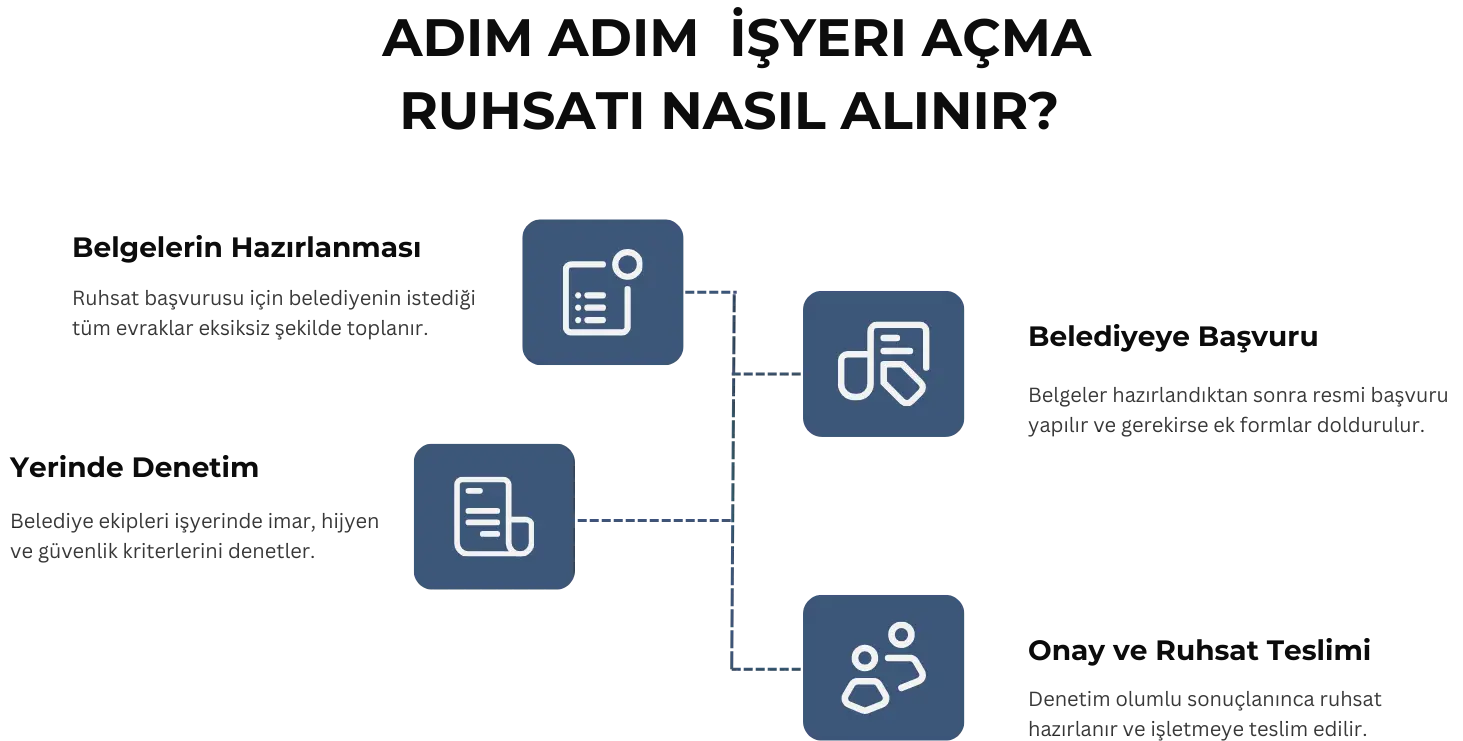
A shop opening license is the most critical document for your business to officially start operating. Businesses opened without this license face high fines and the risk of being sealed. Each municipality may have its own procedures, but it is not possible to start official operations without obtaining a business opening permit from the municipality. So how does the process work?
1. Preparation of Documents: The first step is to collect all the documents requested by the municipality completely. A municipal license application made with missing documents can delay the process by at least 2–3 weeks.
2. Application to the Municipality: Once the documents are ready, you submit your official application to the municipality. During the application, additional forms or petitions may be required depending on your field of activity. For example, the municipality may request a “noise measurement report” from an entrepreneur opening a café.
3. On-Site Inspection: After the application, municipal teams visit your workplace to check criteria such as zoning, safety, and hygiene. If the inspection is not successful, your licensing process will be suspended.
4. Approval and License Delivery: Once you pass the inspection, your license is prepared and delivered to you. You can now legally start your business.
Business Opening Costs and License Fees in 2025
So, how much will it cost to open a business in 2025? We examined the current situation based on municipal fees and additional expenses. The answer is not a single figure because the business license fee paid to municipalities in 2025 varies depending on the size of the workplace and the type of activity.
We can summarize the current situation for 2025 as follows:

These figures are averages; each municipality may have different rates. Additional documents such as fire inspection reports, distance maps, and hygiene certificates are often charged separately. Also, the process doesn’t end with the license; notary procedures, engineering projects, signage costs, and software systems should also be included in the opening budget.
Workplace Opening KOSGEB Support (2025 Updated Guide)
One of the most frequently asked questions by entrepreneurs is about KOSGEB support for opening a workplace. Updated in 2025, this support program provides significant financial advantages to entrepreneurs at the startup stage. Especially during periods when initial investment costs are high, KOSGEB grants and interest-free support loans offer a major advantage for your first investments.

1. Practical Entrepreneurship Training: The first step to applying is to take Practical Entrepreneurship Training. These courses can be completed quickly online or in-person. This training provides basic knowledge on preparing a business plan, financial management, and establishing a sustainable business.
2. Business Plan Preparation: When applying to KOSGEB, you need to present a detailed business plan. The more detailed and realistic your information about your target audience, business concept, cost and revenue estimates, and sustainability, the higher your chance of approval.
3. Required Documents for Application: To apply for KOSGEB workplace opening support, you need to submit specific documents completely. Properly prepared documents greatly contribute to the speedy processing of your application.
The following documents are requested during the application process:
• Identification and business registration documents
• Chamber registration/activity certificate
• Signature declaration or circular
• Trade registry gazette (for sole proprietorships, artisan registry)
• Prepared business plan and KOSGEB commitment
KOSGEB support does not only provide financial resources to entrepreneurs. It also offers consultancy, training, and business development opportunities during the business setup process. This allows entrepreneurs to enter the business world with stronger foundations.
Things to Do After Obtaining a Workplace Opening License
You have obtained the license, but the process doesn’t end here. The license only provides the legal basis for your business; what follows involves conducting your operations safely, orderly, and customer-friendly. Here’s what you need to do during this process:
Post the Tax Plate at the Workplace: After obtaining the license, the tax plate should be displayed in a visible spot at your workplace. This is mandatory for official inspections and builds trust in the eyes of your customers.
Complete SGK Notifications: If you employ staff, you must complete the SGK employment notifications. This protects employee rights and prevents potential fines in the future.
Prepare Signage and Markings According to Regulations: Your business signage must comply with municipal standards. Incorrect size, inappropriate lighting, or unclear address can lead to extra costs and warnings.
Obtain Additional Permits According to Activity Area: After receiving the license, also complete permits specific to your business type. For example, food businesses require staff hygiene certificates and health reports, while entertainment venues require copyright licenses and alcohol permits.
Prepare Business Opening Arrangements: Set up your kitchen or work area according to standards. Prepare your inventory and implement a prescription-based stock system. This ensures uninterrupted service from day one. Train your staff and clarify task assignments.
Plan Inspection and Control Processes: Even after obtaining the license, municipalities or relevant authorities may conduct periodic inspections. Conduct internal audits to continuously maintain hygiene, safety, and inventory control.
The license is only the beginning. To open your workplace safely, legally, and customer-friendly, follow the above steps carefully. This prevents potential fines and lays a solid foundation for the long-term success of your business.

Things to Consider During Workplace Opening and Licensing Process
If you are thinking about opening a workplace, you should know that it’s not just about having a good idea. A well-prepared business plan, complete licensing documents, and timely applications are essential for a smooth process. Even a small paperwork error can cause weeks of delays and extra costs. Therefore, obtaining the updated document list from the municipality and checking each detail carefully will save you significant trouble.
For first-time entrepreneurs, professional consultancy can be truly life-saving. You complete legal requirements correctly and avoid wasting time on incorrect applications. Moreover, many official documents can now be obtained within minutes via e-Government: residence certificate, tax plate, chamber registration… All at your fingertips.
Remember, obtaining the license is only the first step of the journey. The real challenge is managing your business sustainably and efficiently. At this stage, digital solutions come into play. With KOSGEB support, proper accounting systems, and a POS system, you can streamline operations and improve customer satisfaction.
If you want to secure your business legally while taking advantage of digital solutions, simplify your operations and increase your profit with Menulux!
Frequently Asked Questions (FAQ)
1. Can I open a workplace without a license?
Unfortunately, no. Businesses opened without a license are both fined and sealed. Therefore, you must obtain your license before starting operations.
2. How do I obtain a workplace opening license?
You need to apply to your local municipality. Prepare and submit the required documents (title deed or rental contract, tax plate, ID copy, etc.). Once the documents are complete, the license is issued.
3. How many days does it take to get a workplace license?
If all your documents are ready, the process generally takes 15–30 days. Missing documents can extend this period.
4. Can I open a workplace at my home address?
For freelance work (e.g., software, consultancy, design), you can use your home address. But for food, manufacturing, or entertainment businesses, a home address is not suitable.
5. Is license renewal necessary?
Yes, in some cases it is mandatory. If you change your address or business activity, you need to renew your license.
6. Is a master certificate required for every business?
No. Master or journeyman certificates are only required for specific professions such as hairdressers, beauty salons, and restaurants. They are not required for every business.
7. What determines the license fee?
It varies based on your municipality, business square meters, and activity type. On average, you may pay between 1,500 TL and 15,000 TL.





 Nida Kule, Atasehir Barbaros Mah.
 0850 346 6586
 info@menulux.com